Deployment to hardened baselines
Self-hosted or Privilege Cloud, configured to the controls you report against rather than to installer defaults.
CyberArk is the enterprise standard for privileged access, and getting full value from it takes more than a license. We handle CyberArk implementation end to end: deployed to hardened baselines, integrated with your environment, and handed over for your team to own — or run for you as a managed service.

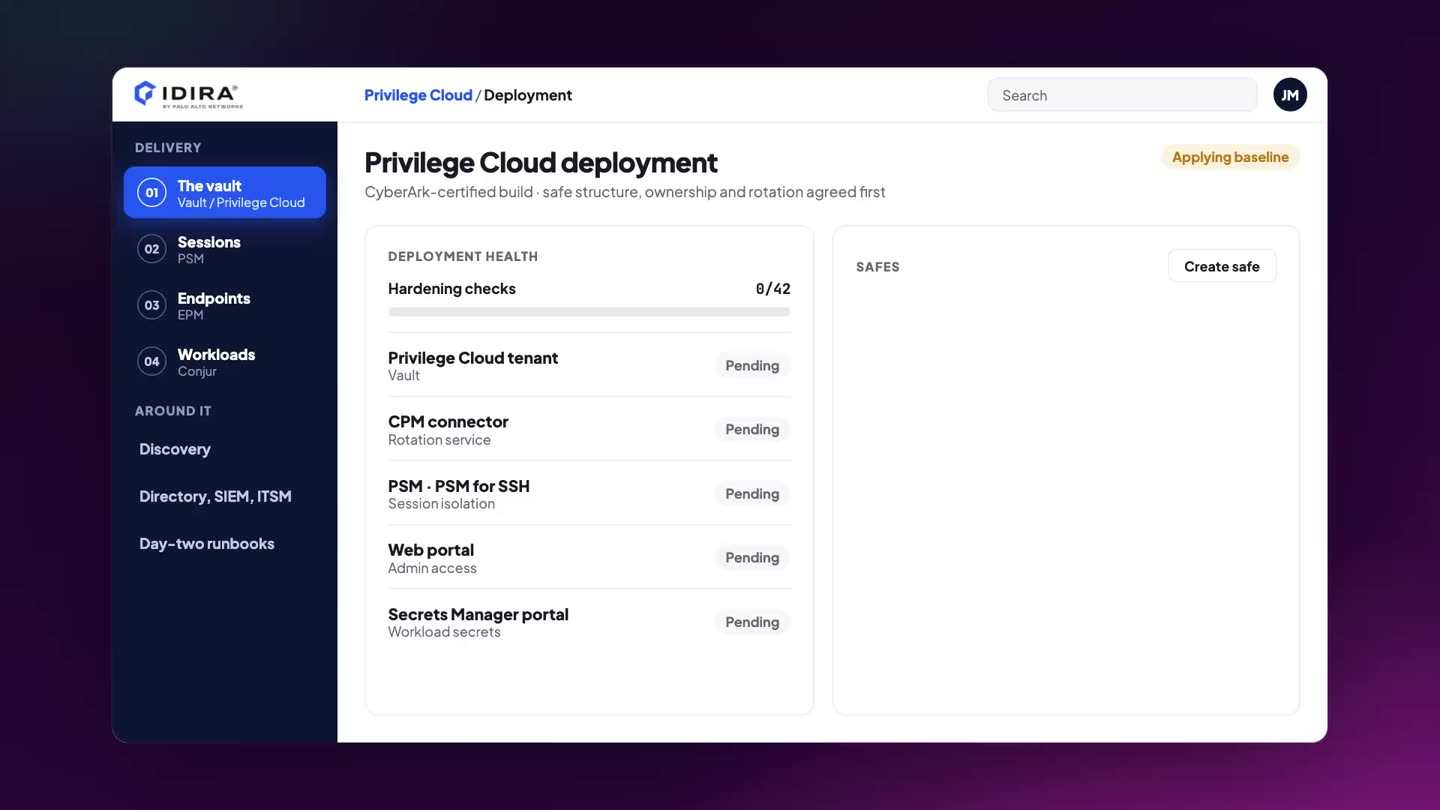
CyberArk PAM is not one product. It is a set of components that have to go in the right order, and most stalled rollouts we get called into stalled because that order was wrong.
The vault comes first, self-hosted or Privilege Cloud, with safe structure, ownership and rotation policy agreed before a single account is onboarded. Get that wrong and you spend the next year unpicking permissions. Then privileged session management, so administrative sessions are brokered, isolated and recorded rather than run from an engineer's laptop. Then endpoint privilege, to strip local admin rights without breaking the applications people actually need.
Around all of that sits the work nobody scopes properly: discovery of the privileged and service accounts nobody documented, integration with your directory, SIEM and ITSM, and the runbooks your team needs to operate the platform on day two.
We roll out in waves, highest-risk accounts first, so audit exposure drops in the first few weeks rather than at the end of a twelve-month program. For the full picture — the range by environment type and what it asks of your team — see PAM implementation. For what each component does, see CyberArk modules in detail. And if you are still comparing platforms, we have written up how CyberArk compares to BeyondTrust, Delinea and Keeper.
Self-hosted or Privilege Cloud, configured to the controls you report against rather than to installer defaults.
Find the unmanaged privileged and service accounts, then onboard them into the vault in controlled waves.
Brokered, isolated and recorded privileged sessions, including secure remote and third-party access without a VPN and a shared password.
Local admin rights removed and elevation granted only for approved actions, deployed audit-first so you know what would break before anything is enforced.
Application, DevOps and machine credentials brought under CyberArk control, out of code and configuration files.
Directory, SIEM and ITSM wired in, with runbooks your team can operate — or we operate it for you.
A clean build, which is the fastest and the rarest.
The most common engagement by some distance. The vault exists, the first onboarding wave finished, and then it stopped. We assess what is live, what has drifted and what was never finished, then get it to a state your team can run.
It works, but the person who understood it has gone and nobody has touched it since. This usually turns into managed IAM services or training and enablement, depending on whether you want to keep it in-house.
Almost always for the same three reasons, and none of them are product problems.
Because nobody owns the discovery of the remaining privileged and service accounts.
So admins keep a bypass route and use it.
So the platform quietly becomes one engineer's side project.
A stalled rollout is an operations gap rather than a product fault, and it is fixable without starting over.
CyberArk CDE for PAM and EPM, CyberArk Guardian, Sentry and Defender, held by named engineers. Hands-on vault installs, PSM hardening, CPM troubleshooting and EPM rollouts — not a license drop.
Palo Alto Networks completed its acquisition of CyberArk on 11 February 2026, and the identity portfolio now carries the IDIRA name. The components have not changed, and neither has the delivery work. We are a partner on both sides of that — see Palo Alto Networks for the wider platform.
Our engineers designed automated credential replication between the primary PAM environment and cloud key vaults, so privileged access survives an infrastructure outage without manual break-glass. 95% reduction in credential provisioning time during a disaster scenario, and 300+ privileged accounts onboarded in minutes rather than days.
20,000 privileged access requests a day validated against change tickets automatically, with approval time down from 15–20 minutes to under five. How the change-validation integration works
Yes. CyberArk is a privileged access management platform. Its core job is securing the accounts that can change systems, reach sensitive data or switch off security controls: vaulting those credentials, rotating them automatically, enforcing approval before use, and recording privileged sessions. The wider platform extends into endpoint privilege, secrets management and cloud entitlements, but PAM is the foundation.
We implement. Certified delivery engineers deploy CyberArk to secure baselines, integrate it, onboard accounts, and can run it afterwards. Licensing is part of it, but the value is in the delivery.
It depends on the environment, and discovery is what decides it. In projects we have delivered, cloud-native estates took about 40 to 60 days, mid-sized hybrid estates two to three months, and large or legacy estates six to 18 months or longer. The full breakdown is on our PAM implementation page.
Yes, but not in one pass. We phase it by risk and by population: domain and infrastructure admins first, then application and service accounts, then broader endpoint privilege. Remote and third-party access goes through brokered sessions rather than VPN plus shared credentials, which is usually what makes distributed rollouts workable. More on distributed rollouts
CyberArk is the deepest enterprise platform, and the right fit for large, complex, heavily regulated environments. Keeper is modern, faster to deploy and more cost-effective for smaller organizations, MSPs and cloud-first teams. We deliver both and recommend based on your environment, not a quota.
Yes. Deployments go to hardened baselines mapped to PCI-DSS, SOX, HIPAA, GDPR and NIST, and we have delivered across finance, healthcare, insurance, energy and education. Evidence collection is built into the rollout, so audit questions get answered from the platform rather than from a spreadsheet. See identity security for finance.
Yes. Hand it over to your team, or let us operate it — monitoring, onboarding, rotation and audit-ready reporting — on its own or as part of a broader managed engagement.
Most environments start with the vault, or Privilege Cloud, plus session management, then add endpoint privilege and secrets once the foundation is stable. Buying the whole platform at once is the most reliable way to stall a rollout. What each module does is covered on CyberArk modules in detail.
An AI agent is a service account that makes its own decisions. Most of what you need to control it already exists — and the part that is genuinely new is smaller than the marketing suggests.
Sep 30, 2026
PAM secures the accounts with the most system power. Here's what privileged access management does and why attackers go after these credentials first.
Jul 28, 2026
Standing privilege is what turns one compromised account into a bad week. Here is how just-in-time access actually works in practice.
Jul 27, 2026Tell us where you are — a new rollout, a deployment that needs hardening, or day-to-day operations — and a free consultation will scope the right path with certified engineers on it. You get the findings in writing.
Needed for the site to work — page delivery, and the spam protection on our forms. These do not track you and cannot be switched off.
Google Analytics and Microsoft Clarity, so we can see which pages are useful and which are confusing. Clarity hides anything you type into a form. We use this to improve the site, not to identify you.
ZoomInfo WebSights, which tells us which organisation a visit is likely to have come from and which pages were read. With this on, ZoomInfo may also set third-party cookies that help it recognise a visit across other websites, and may share that with its own partners. Turning this off stops all of it.